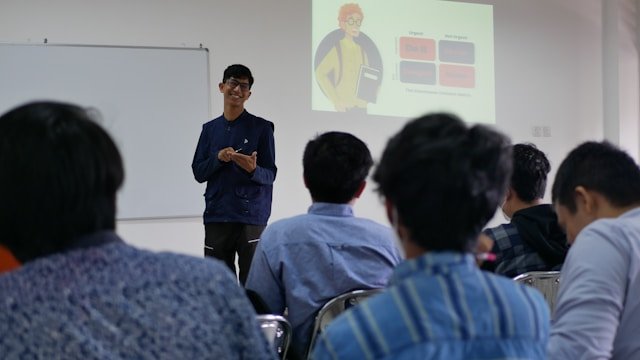

.
🛰️ Satellite Creation Workshop: Turning Indian College Students Into Space Builders
In an era where space technology is no longer confined to ISRO or NASA, Indian students are rising to build, launch, and innovate in the next frontier — space.
Imagine being in college and building something that could orbit Earth. That’s not science fiction anymore — that’s what the Satellite Creation Workshop is all about.
🌍 The Vision Behind the Satellite Creation Workshop
India has entered an exciting phase of its new space economy — with the rise of private players, space startups, and student-led satellite missions.
From the success of PSLV-C53’s student payloads to the Chandrayaan and Aditya missions, space is now a place for dreamers, makers, and learners.
The Satellite Creation Workshop brings this dream down to the campus level — designed to inspire, educate, and enable students to design, simulate, and even prototype their own nanosatellites.
This isn’t just a seminar; it’s a hands-on engineering and innovation experience for Indian college students who want to step into the future of aerospace, IoT, communication systems, and hardware design.
🚀 What is the Satellite Creation Workshop?
The Satellite Creation Workshop is a multi-day, experiential learning program that takes students through the complete journey of satellite creation — from concept to prototype.
It’s designed for engineering, science, and technology colleges across India and covers:
🧠 1. Foundation & Space Systems 101
Understand how satellites actually work — from power and communication subsystems to orbital mechanics.
Students learn about nanosatellites, CubeSats, and their role in modern space missions.
"You’ll explore how small satellites are used for Earth observation, IoT connectivity, and even climate research."
🧩 2. Design Thinking for Space Missions
Every great satellite begins with a purpose.
Students work in teams to identify real-world problems that can be solved using space-based data or systems — from agriculture monitoring to disaster management.
Through guided sessions, they develop Mission Objectives, define constraints, and build Mission Design Canvases — just like actual aerospace teams.
⚙️ 3. Hands-On Hardware & Simulation
This is where theory meets creation.
Students dive into hands-on labs and design simulations to understand satellite architecture.
Key activities include:
Understanding satellite subsystems (Power, Communication, Thermal, Payload, Structure, ADCS)
Using open-source tools for orbit simulation and payload analysis
Learning about sensors, telemetry, and data transmission
Assembling functional satellite mockups or payload prototypes
"The idea is to make every student feel what it’s like to build something that could literally go to space."
🧰 4. Payload & Data Communication Module
Learn how the satellite “talks.”
Students build simple payload modules that capture and transmit sensor data.
They explore:
Onboard microcontrollers (Arduino, Raspberry Pi, or ESP32)
Sensors for Earth observation and telemetry
Communication links and ground control basics
Real-time data visualization
This gives them a hands-on foundation in IoT for Space, a skillset that’s increasingly valuable in both aerospace and modern tech industries.
🛰️ 5. Building the Prototype
By the end of the workshop, students will have:
A working satellite prototype or subsystem model
A mission report defining objectives, design, and expected data
Experience working as an interdisciplinary space team
Some colleges even extend this workshop into a semester-long project that can lead to actual student payload launches in partnership with academic or private space agencies.
🌌 Why Indian Students Need This Experience
India’s space-tech industry is projected to be worth over $40 billion by 2040, and it needs more than just scientists — it needs builders, problem solvers, and engineers who can work across disciplines.
Yet, most Indian students never get exposure to real space engineering, satellite systems, or payload design while in college.
The Satellite Creation Workshop changes that. It:
Bridges classroom theory with real-world space applications
Encourages collaboration between electronics, mechanical, and computer science departments
Builds skills in STEM, hardware design, product thinking, and team collaboration
Helps students explore new careers in space-tech, data analytics, IoT, and defense technology
💫 Learning Outcomes
By the end of the workshop, participants will:
✅ Understand the complete lifecycle of a satellite mission
✅ Learn how to design, simulate, and prototype nanosatellites
✅ Gain exposure to payload integration and data telemetry
✅ Strengthen teamwork, project management, and documentation skills
✅ Receive a certificate of participation and innovation — a powerful addition to any engineering portfolio
🧭 Program Format
Duration: 3 to 5 days (customizable)
Mode: On-campus, hands-on, instructor-led
Team Size: 5–6 students per team
Output: Satellite prototype / subsystem demo + mission report
Mentorship: Aerospace experts and industry mentors
👨🚀 Who Should Attend?
This workshop is perfect for:
Engineering students (ECE, EEE, Mech, Aero, CS, Mechatronics)
BSc/MSc Physics or Space Science students
Budding innovators, tech hobbyists, and makers
Campus clubs (Robotics, Electronics, Space, AI, Innovation Cells)
No prior aerospace experience is required — just curiosity and a willingness to build.
🏁 The Bigger Goal: Democratizing Space Learning in India
Space education shouldn’t be limited to elite research centers.
Through the Satellite Creation Workshop, the goal is to bring space learning to every Indian campus — from Tier-1 universities to small-town engineering colleges.
It’s about sparking curiosity, building practical skills, and inspiring students to dream beyond the sky.
Because when students build satellites, they’re not just making machines — they’re building belief.
Belief that India’s next big discovery can come from a dorm room, not just a launch pad.
"Look at the sky. We are not alone. The whole universe is friendly to us and conspires only with those who dream and work"
Sir A.P.J. Abdul Kalam